Links to some of my other work

Here are links to some of my other published stories, available online.

CHILDREN OF THE MOON was winner of the 2020 TL;DR herd flash fiction contest and is also published in the anthology, “Endless Pictures”: http://tldrpress.org/index.php/1kwhc-flash-fiction-winner-children-of-the-moon-by-rob-mcivor/

HOPE GROWS appeared in the Cabinet of Heed’s collection of Covid-inspired stream of consciousness stories: https://cabinetofheed.com/2020/04/08/stream-of-consciousness-drawer-two/

COLD COMFORT, a cautionary tale for skiers, also appeared on the Cabinet Of Heed website: https://cabinetofheed.com/2020/07/02/cold-comfort-rob-mcivor/

A SHOEBOX FULL OF LOVE LETTERS was a runner-up in the Retreat West themed flash competition in September 2020: https://www.retreatwest.co.uk/a-shoebox-full-of-love-letters/

MAY YOUR DAYS BE MERRY AND BRIGHT was published in December 2020 by Fairlight Books as one of four weekly seasonally-themed stories: May Your Days Be Merry and Bright by Rob McIvor | Fairlight Books

DRIVEN HOME was published in July 2021 by Janus Literary: Driven Home – Janus Literary

POWER PLAY was published in July 2021 by Lucent Dreaming: Power Play by Rob McIvor (Lucent Dreaming Issue 9) – Lucent Dreaming

A SATURDAY ON THE MAINLAND was published in November 2021 by Flash Fiction Magazine: https://flashfictionmagazine.com/blog/2021/11/19/a-saturday-on-the-mainland/

Late Lunch

Formal place settings at a table for two - Free Stock Image

This story first appeared in the Ellipsiszine anthology, She Cries Honey, in March 2020. The print edition is now sold out but the digital version is still available and contains some wonderful pieces – https://www.ellipsiszine.com/seven/

Christine looked younger than Nicholas had anticipated. True, there were streaks of grey in the auburn hair, but she was nearly 60, after all. She doesn’t dye it, he thought. Of course. He should have expected that.

He stood as she approached the table, wondering whether he should offer a handshake or go to kiss her. How many years was it since he had last done this? What was appropriate, at their age and in these circumstances?

She rescued him, clasping his proffered hand with her left, placing her other on his upper arm and air kissing him. He felt her breath wisp his cheeks. 

“Hello Nick,” was all she said, as she stepped aside and took her seat.

Without asking, he poured water. He hadn’t ordered wine, unsure whether she would want to drink. It was lunchtime, after all. Different rules applied, at least here in town. 

He fiddled with the knot of his tie. Too formal? At other tables, suited men – presumably talking business – sported open collars. No, she would have expected a jacket and tie. Has she dressed up for him? He tried to study her clothes without being obvious. The dress wasn’t new – he could see tiny signs of wear around the tips of the collar – but she would surely be aware of how it flattered her. 

They skimmed their menus while scrabbling for ways to begin the conversation. Yes, she had found the restaurant easily; no, he hadn’t been waiting long; no, she didn’t need to be away by a particular time; yes, he’d have a starter – if she was going to.

She would have some wine, thank God. He suggested a Sancerre; she agreed.  

“Small or large?”

“I booked a taxi from the station. Why don’t we share a bottle?” 

He felt the coil in his stomach unwind a couple of turns. It was going to be all right. She wanted this to succeed as much as he did.

They ordered and began to put flesh on the bones of what each already knew about the other’s life. Home for her was a converted barn – chosen because the huge windows flooded it with light for her paintings, some of which had been sold through a local gallery. There were dogs, cats, even a horse; she grew vegetables and played violin in an amateur quartet.

He lived on a modern housing estate, a functional purchase when he had been tossed into civilian life at 55 and needed somewhere with enough space for himself and three daughters, should they all choose to visit at the same time. He kept himself busy with the neighbourhood watch, the bowling club committee and the Conservative Association.

As they began their main courses, he brought up the wedding, a little over a month away. Nicholas wasn’t entirely sure about his daughter’s choice – a bit lefty for his liking – but everything about the day still had to be perfect.

“Organising it all reminds me of being back in the service,” he said. “Emily isn’t at all interested in the details but, as I say, if you fail to plan…”

“You plan to fail.”  Something flirtatious about the way she caught his eye as she finished his sentence made him uncomfortable. He didn’t want to do or say anything inappropriate.

“I suppose all those years of moving soldiers around the world have come in handy, then.”

“Exactly.  It’s essential that everyone knows where to be, what to do and when to do it.”

She smiled, teasingly.  “No room for a bit of spontaneity?”

Nicholas looked away, discomfited. Being spontaneous 35 years ago had led him to propose to a flame-haired beauty he had met only a month before. She had captured him with her free-spirited passion for self-expression; he had imprisoned her in the claustrophobic cage of the army wife. 

“You should always be prepared to be spontaneous,” she said, draining the last of the wine. She took out a tissue and dabbed her lips. “Another glass?”

She caught his slight hesitation and looked at him questioningly.  “Are you worried that I’ll misbehave?”

There was a long pause before he replied. Memories flooded him: married quarters devoid of children’s voices; wardrobes emptied of clothes; a regretful note propped up against the kettle.

“No,” he said softly.  “The girls say your days of misbehaving are long past.”  He smiled as he spoke, trying to reassure her, but stopped, seeing dampness at the corners of her eyes.

“Sorry,” he said.  “That was clumsy of me.”

Christine patted her eyes with the tissue. It was shredded at the edges; he hadn’t noticed her wringing it as he spoke.  

“Are you sure you want me at the wedding? Since you’re paying for everything.”

“Of course I do. More importantly, Emily does. All the girls do. That’s why they arranged this, isn’t it?”

She smiled. “Well, it sounds as though they’re not being allowed to do much of the organising. Emily is taking me shopping, though, to choose an outfit.”

“Well don’t pick anything too flattering,” he laughed. “You’re not allowed to look more beautiful than the bride.”

He cursed himself. He hadn’t meant to say anything like that. But she was beautiful. Still.

She smiled away the compliment and steered the conversation back to his schedule of ushers’ duties, seating plans and food. The care with which he approached even the smallest detail, the love that it signified, reminded her why she had first been attracted to him. They drained their glasses and, with a conspiratorial chuckle, she called for two more. This time, he didn’t hesitate. 

When she got up to leave, he stood too and this time took the initiative, kissing her on each cheek. 

He sat down, gesturing for the bill, and watched her go. As she walked away, he ached for her to look back towards him, just once. But she didn’t and, finally, after 25 years of thinking about this moment, he understood that she never would.

Lucy’s Law (#IfItSaves1Life)

For the second round of the NYC Midnight Flash Fiction Challenge, I was given the prompts: political satire, a bicycle shop and a bikini. Here’s what I did with them, again in 48 hours…

Synopsis: How can cycling be made safer? One bike shop co-owner thinks she has the answer, and soon it seems that everyone is behind her campaign, but is she missing the point – or not going far enough?

I was in the workshop early one morning, truing a wheel for a customer, when Lucy burst through the door. I’d like to claim that the first thing I noticed about the co-owner of our bike shop was her beaming smile, but it wasn’t. It was that the only thing she wore was a bright green bikini. 

I didn’t need to react, beyond giving her a quizzical look.

“This is what I’m wearing to cycle in from now on,” she announced. “Last night, someone broke into my locker at the swimming pool and I had to ride home like this. I didn’t get a single close overtake, sideswipe or anything nasty.”

I hesitated before responding. A few days earlier she had been knocked off her bike by a driver who claimed not to have seen her. She’d observed, with some justification, that anyone who failed to see a six-foot two woman with a billowing mop of red hair really should be holding on to a guide dog rather than a steering wheel.

“So, you’re saying that wearing a bikini made riding your bike safer?”

“Exactly. And if everyone wore one – well, men could wear trunks – drivers would realise how vulnerable we are and would take extra care not to drive into us. There wouldn’t be so many injuries and deaths. We should start selling swimwear instead of the usual cycling kit.”

Watching her step through into the main part of the shop and shimmy past the display bikes to unlock the front door, I told myself there was no point arguing. Five years of running Blackheath Bikes together had taught me that that trying to stop Lucy when she had a big idea was futile. The next day there was a poster in the window exclaiming “STAY SAFE – BIKE IN A BIKINI”. 

Within a couple of weeks, we had a display of swimwear in the window and several times a day I would overhear Lucy recounting her tale and urging customers to follow her lead. Some objected, of course, saying they would look silly or that they would only wear one when their friends did the same, but Lucy could be very persuasive and it wasn’t long before we were ordering more stock.

A few weeks later, we were visited by a reporter from the local newspaper. He must have sold the story on to a national because it went crazy after that. I arrived at the shop one morning to encounter, Lucy – in her bikini – being interviewed by the BBC. Within days, the media were reporting bike shops all over the country starting to stock swimwear. Manufacturers were announcing ranges for mountain biking, road racing and commuting. Hashtag IFITSAVES1LIFE was soon trending on Twitter.

Our local MP weighed in, proposing “Lucy’s Law”, to make it illegal to ride a bike without wearing swimwear. Critics argued that bikinis offered no protection to someone hit by a car but were shouted down by people with stories of how their lives had been saved by their Speedos. Even the Prime Minister, who was known to cycle fully-dressed, added his support. “If it saves one life, perhaps a child’s, then it is worth it,” he said in Parliament.

When a famous actor was knocked off his bike by a delivery van, breaking several bones, newspaper columnists chided him for not wearing swimming trunks. Obviously, it was his own fault that the van driver drove into him.

I thought it would all be over by Christmas, but when I saw see-through skinsuits with thermal bikinis – heated by clip-on battery packs – being featured in a Cycling Weekly spread on clothes for winter riding, I had to admit that Lucy had started something big. Our shop had become famous by association, but she personally was being touted as a role model for young women and there was talk of the Queen awarding her an O.B.E. for services to road safety.

Was I jealous of the attention? A little, I’ll admit, but I was still not entirely convinced. Even when it was announced that the next Tour De France would be ridden in trunks, with the sponsors’ logos across the rear, despite there being no chance of those riders encountering a dozy trucker, I continued to cycle in T-shirt and shorts.

“Wouldn’t it be better to build protected cycle lanes, so cars and bikes didn’t have to share the same space?” I suggested to our MP, but she dismissed the idea.

“This isn’t Holland, you know,” she said. “If you put cycle lanes at the side of every road where would people park?

“Wearing swimwear is something all cyclists should do to protect themselves. After all, it’s their responsibility to stay safe.”

Lucy’s Law didn’t pass, but by now there was so much pressure on all cyclists to comply with its intentions that those who resisted were often subjected to abuse, even by other cyclists.

Yet, for some reason, cyclists continued to die. Every few weeks, the media would feature another grieving relative, expressing horror that their loved one had been killed despite “always wearing their swimwear” on their bikes. It was becoming clear, even to the politicians, that bikinis were not the answer. Something more was needed.

Perhaps fittingly, it was Lucy again who came up with the answer. One morning, even though sporting a fluorescent yellow and blue polka dot bikini, designed especially for her by Stella McCartney, she suffered yet another sideswipe, leaving her with cuts and bruises down one side. She brooded all day until, as she was locking up the shop, she declared that she knew what she needed to do.

“Bikinis aren’t enough,” she said. “We’ve got to do even more to protect ourselves.” 

She disappeared into the bathroom, emerging a few minutes later, ready for her ride home.

“This is the answer,” she said.

I looked up – and that was the moment at which I learned that my business partner had a tattoo of Lance Armstrong on her left buttock.

Good For Breeding

This was my first-ever piece of Flash Fiction, published in 2018, well before the BLM movement gathered pace. However, it seemed timely to re-post it here.

iu-6

It was the shouting that pulled Omolara back from the edge of sleep.  A woman’s voice, pleading and cajoling; a young girl, clawing breathlessly for words; men’s voices, harsh and mocking; a cacophony of chaos invading her tiptoed steps into restfulness through the broken window of the shack.

She covered her baby’s ears and squinted through the dirty pane. She recognised the screaming woman; she and her child slept in the shack adjoining her own. The girl was flailing against a burly man who was trying to tie her arms behind her back. Another stood by, whip in hand and a cigarette hanging precariously from his lips.

The mother lurched forward, scratching and spitting at the man holding her daughter. There was a loud crack, accompanied by a curse. The woman fell to the ground. The man drew on his cigarette, then stubbed it out with his boot.

Omolara felt a slight pressure on her shoulder as an older woman joined her at the window. It was “Mama”, as all the young women in the shacks called her. Too old now for hard manual work, she had been permitted to stay on the farm in return for looking after the newly-born babies when their mothers were sent back into the fields.

“What’s happening, Mama?” she murmured, although inside she already knew what was going on and did not want to acknowledge it.

“It’s time for Ebele to be sent away,” said the older woman. “She’s almost a woman now. Another master will pay well for her.”

“She will be good for breeding.”

“Good for breeding.” The words ricocheted in Omolara’s memory. She saw herself, standing half-naked on the dockside platform as the men ogled and pawed her, pretending that their scrupulous examination was only as it would be for any other farm animal. “A fine young one,” the auctioneer had shouted.  “This one will be good for breeding.”

“And I’m sure you’ll have no trouble finding her a good strong bull,” he added, leering at her exposed breasts, which were not yet revealing the presence of the child that was to emerge some seven months later.

Outside, the shouting died down as Ebele was dragged away, still thrashing and calling out for help. Her mother lay disjointed on the ground with her arms and legs splayed, as though death had taken her already. She was sobbing – deep, seemingly endless, howls of anguish that pierced Omolara’s heart. They were like no sounds a human could make. Some of the other women gathered around, trying to comfort, but the wailing continued.

“Will she see her again?” asked Omolara, again fearing the answer.

The older woman paused. “She may be lucky. Ebele’s a pretty girl. Maybe the master will keep her for a while. Or he might let one of the men have her. Then she can come back for visits.”

Omolara shuddered. She had already learned that her owner saw it as his right to relieve his stress with his female assets and that those he did not choose, or had discarded, were often passed on to the foreman and his lieutenants. The numerous paler-skinned children around the farm were testament to that.

“I don’t think that will be, though,” Mama added. “She will be worth more at the market if she is still pure.”

Omolara lay back on the cot and gazed at her tiny daughter.  What would she look like when she was 12 or 13? Would she be pretty enough to be favoured by the master, she wondered, or would she be discarded at the market, sold off to the highest bidder, along with the other stock?

She thought of her husband’s look of defiance as he was chained at his hands and feet and hauled off to another part of the ship that had brought them both to this humid and heartless land. Although they had crossed the Atlantic only yards apart, she had never seen his face again.

Where was he now? Had he ever received the message that she had tried to send, whispered from prisoner to prisoner through the ship? The message that he was to be a father.

Eyes now closed again, she tried to conjure his face before her, but could not. It was though the memory of him, of the five months they had shared before they had been sold to the traders, was resignedly erasing itself. Soon it would be gone forever, as if it had never been.  This was her life now.  This would be her daughter’s life. Life itself had been the only gift her mother could bestow upon her and it had been despoiled from the moment, a few days before, that she had given her first cry.

Omolara licked her fingers and held them to the child’s mouth, feeling the warmth of her breath drying the saliva. A tear slipped from her eye and landed on the baby’s cheek.  Unsure whether she was crying for herself or for the child, she closed her hand over her daughter’s mouth and held it there, gently but firmly, until the warm air ceased to brush her palm.

She pulled the tiny body to her chest. She knew that tomorrow, for her, there would be punishment and pain but for now she closed her eyes and begged for sleep, to dream of her little girl, now enjoying the freedom that she herself would never again know.

A version of this story was first published on http://www.ellipsiszine.com

No sleep till Southend – how I learned to love cycling again

I didn’t go to bed last night.

No, I wasn’t at an all night party – if such things still take place – but on a bike ride. While sensible people were tucked up in their beds or, at least, slumped in front of their televisions wondering how it’s possible to have 360 channels to choose from and still be unable to find anything worth watching at two in the morning, I, together with a fair number of others, was riding out from London, through the Essex countryside, on my way to Southend-on-Sea.

Let me introduce you to the Friday Night Ride to the Coast, an idea so simple that it’s hard to understand why nobody thought it years ago and so completely bonkers that it’s sometimes equally hard to understand how someone ever did come up with it.

This is what happens. At a little before midnight on a designated Friday night – like last night – a group of people gather, with their bikes, just by the National Theatre on London’s South Bank.  At exactly midnight, they set off and cycle to somewhere on the coast, where they all have breakfast at a café or even a pub. Most then take a train back to London, in good time to get on with their weekends. A few will cycle back, in what’s informally known as the Saturday Morning Ride Back to London.

The rides are eminently sociable affairs, evidenced by the mix of participants and their bikes. Alongside racing snakes on their super lightweight frames, you’re likely to find middle-aged ladies on hybrids, hard-bitten Audax riders with steel frames and capacious saddlebags, a few fixed gear enthusiasts with calves of steel, the odd recumbent and, almost guaranteed, a contingent of Bromptons. And here’s the joy: nobody cares what you’re riding so long as it’s mechanically sound. FNRttCs are, without doubt, the most egalitarian rides I’ve ever joined.

About 18 months ago, not long after finishing a gruelling 1400km London-Edinburgh-London randonnee, I wrote that I had temporarily lost my enthusiasm for riding. It was a while before I got back on a bike for anything other than a local pootle and it was joining a FNRttC, to Shoreham, that reignited my love of cycling and gave me back my mojo.  Yet, apart from the need for a decent set of lights, it’s hard to imagine anything further removed from Audax-style riding.

Most noticeable is that the pace is, to put it mildly, gentle. That’s not to say that there’s no scope for belting along country lanes by the light of the moon if that’s what you fancy, but the guiding principle of the FNRttC is that no one gets left behind and no one is allowed get lost.  Each ride has a leader and a back marker (or Tail End Charlie, as the ride organisers describe the role).  Golden rule number one is: never overtake the leader! Golden rule number two is: the Tail End Charlie never overtakes another rider.

If a rider has a mechanical problem, such as a puncture, the Tail End Charlie will wait with them until it is fixed. If the rider needs to pop into the bushes, as many do on long rides, the Tail End Charlie will wait with their bike until they are back on the road.

Inevitably, over time the ride will get stretched out.  Some people will ride faster than others, and nobody minds that. Sometimes the ride leader can be two or three miles ahead of the Tail End Charlie, with riders strung out in clusters along the intermediate roads. To ensure no one misses a turn, at every junction, another rider will peel off from the front handful of riders and wait to direct every other rider until the Tail End Charlie appears, signalling that everyone is through.

It’s a beautifully simple and efficient system that helps to make the rides a real pleasure and a great introduction to overnight cycling for anyone who has not tried it before.

But what’s so special about cycling through the night, I hear you ask.  Where do I start?  Once you’ve left the city, busy roads evolve into peaceful ones, with the only human noise coming from the whirring of chains and the chatter of your fellow-riders. You become aware of the sound of night – the hooting of owls or the rush of air across their wings as they swoop across the road in front of you, animals rustling in the hedges, even occasionally the squeaking of bats or the snuffling of horses in a field. Occasionally there might be close encounter – a badger glimpsed lurking in thick grass at the side of a road; a hare bounding through an adjacent field. One memorable morning, just after dawn somewhere in Sussex, a bird of prey plucked a pigeon from the air just a few yards in front of me. For me, this is one of the most appealing aspects of riding overnight Audax events; the only difference on a FNRttC is that the pace is considerably more leisurely.

On a clear night, the starlight breaks through the upward haze of artificial light or the moon hangs over like a giant egg. As dawn comes, mist rises off the fields, giving the new light a hazy, dreamy quality.

Along the way there is always a food stop. At its worst this may be a 24-hour McDonalds, or similar. (Last night it was the Services on the M25 near Thurrock, which is probably about as bad as it gets.) At its best, such as on several of the rides down to the seaside towns of West Sussex or the popular run out to Whitstable, it’s a scout hut or church hall where volunteers have prepared food for sale, usually with proceeds going to a charity.

Then, finally, usually somewhere between 7 and 9 am, there’s the fun of riding into a seaside town as it starts to wake up for the day, with the breakfast destination in sight. For some, it’s time to dig deep to get through those last few miles. This may have been the longest bike ride they have ever done or the first time they have ridden through the night. What better company than The Fridays with whom to undertake such a challenge?  For others, the old hands who have done this before and know that there’s a certain advantage in being one of the first to get the breakfast order in, it’s a chance to ramp up the speed a bit, and possibly even race past the ride leader.  For all, breakfast is a sociable affair, reminiscing about the hours and miles that have just passed and, inevitably, talking about “the next one”.

Gradually, people drift away, to re-align their weekends with the rest of humanity, those who went to bed the night before and simply have no idea what they have been missing.

Another Friday night ride is over; here’s to the next one.


Not all Friday Night Rides to the Coast begin in London.  For full details of all rides, and lots of other useful information, see The Fridays’ web site: https://www.fnrttc.org.uk

Here’s another thing that bears do in the woods – terrify cyclists

iu-2

It was a glorious August afternoon. The temperature was hovering somewhere in the mid-30s with no humidity and my legs felt supple and strong for the short climb ahead.  Turning off the main road, past the signs warning that the winding lane ahead was unsuitable for vehicles longer than 25ft, I went from open space, with stunning mountain views, to a narrow road with dense, dark forest, banking up on each side.

The only sounds I could hear, apart from the very faint hum of motor boats on the lake a mile or so behind me, were my own breathing and the slight whirr of the chain hauling me upwards. I was in that wonderful mental state in which the mind goes almost completely blank and simply exalts in the pleasure of being outside, on a bike.

Then I met the bear.  And things changed very quickly.

You’ll have released by now that I wasn’t on an Audax UK ride. Our risk assessments tend not to encompass encounters with large carnivores. I was on a family holiday in the USA and had slipped away for a few hours to take a ride up Signal Mountain, a 2,350m ft peak in Wyoming. I wasn’t expecting a particularly challenging ride. The foot of the climb was already at almost 2,000m and it was only another 5 miles to the summit itself, at a fairly benign gradient.

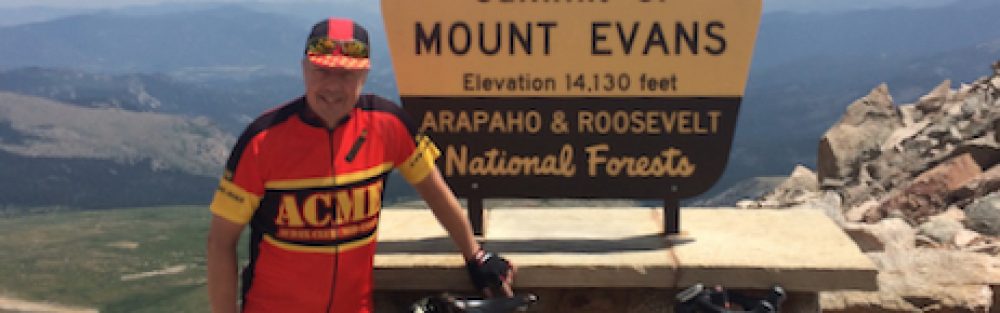
My main reason for trying it was to see how I coped with the altitude. I had suffered badly with asthma on my previous highest climbs, barely more than 2,000m, in the Pyrenees some years before. As I was planning to tackle the 4,260m ascent of Mount Evans in Colorado the following week, I was concerned that I might not be capable of riding in the thinner air above 2,500 metres.

Hence, my focus was my lungs as I pedalled comfortably through the first mile or so of gently undulating forest road, enjoying the peace and musing over what kind of view I would get from the top of the mountain.  I rounded a bend, on a slight incline, and there he was, on all fours, slap bang in the middle of the road about 40 feet in front of me. A fully grown black bear.

I knew about bears, of course. Any visitor to Grand Teton or the adjoining Yellowstone National Park is bombarded with warnings about the danger, the need to stay at least 300 feet away from any bear, the inadvisability of hiking alone and the wisdom of carrying bear repelling spray*.  I had heard all of that advice and, foolishly, assumed that a bear was unlikely to be hanging around on a popular road, with cars buzzing up and down, in the middle of the afternoon.

Now, as I looked at the bear and the bear looked at me, I found myself wondering if I would live long enough to realise what a fool I had been.

I am pleased to recall that I didn’t panic. Had I succumbed to my immediate thought, to turn around and get back down the hill as quickly as possible, you might not be reading this. Thanks to the Lonely Planet guide, I knew that the worst thing you can do when faced with a bear is to run away. Apparently, they enjoy the chase as much as the subsequent meal. So I stopped, dismounted, and backed away, painfully slowly, with the bike held in front of me (as everyone knows, a bicycle is a highly effective defence against a charging bear).

All the time I was avoiding eye contact and talking loudly to make it clear that I was a human. I can’t remember what I was saying but I suspect it was gibberish. I seem to recall that at one point I said something like: “Hello Mr Bear. What a surprise to see you here. I hope you are having a nice day.”

Fear does that sort of thing to you.

All seemed to be going well. I wasn’t too far from the bend and I hoped that once I was out of sight I would be forgotten.  But then a car came down the hill, behind the bear. And rather than stop immediately, the driver helpfully chose to get as close as he could to the animal so that his kids could lean out of the windows and take photos.  Not surprisingly, the bear took exception to this encroachment on to his bit of road and decided to move away.  Towards me.  Luckily, he didn’t move very fast, but I’m not embarrassed to say that I was very scared at this point.  He came a bit closer, now about 30ft away, then stopped again.  Suddenly, there was a new factor to consider – another car that had just come around the bend and stopped immediately behind me.

This was my saviour, or so I thought. There was a certain logic in placing another, large and metal, object between me and the bear. Very slowly, I edged alongside and then around the back of the car.  Caught in a vehicle sandwich, the bear began to pace restlessly from one side of the road to the other, still coming closer towards where I was lurking.  Then, without warning, he leapt up the bank at the side of the road and started to amble among the trees.

I think at that point, all involved assumed that our little encounter was about to be over. Another car had now come down the hill and was spilling its camera-wielding occupants all over the road.  As some of them were small kids, I reasoned that this was helpful as, given the choice, any bear would be bound to go for an easy bite-sized meal rather than take on an adult. On the other hand, he had now re-emerged from the trees and was almost parallel to the car behind which I was cowering.

Not wanting to take any chances, I edged back alongside the car, so that it was still between us.  This turned out to be a smart move as the bear jumped back down on to the road and approached the very spot at which I had been standing.  There were a couple of mountain bikes strapped to the back of the car and, perhaps because they would have the smells of previously-ridden trails on them, these became the focus of his attention.  However, so far as I was concerned, I was still fewer than six feet from a large black bear, so continued to take baby steps back towards the front of the car. I could hear him snuffling, as though he had a bad cold, and, as I thought in my fear, growling a little. A bear’s growling is not a welcome sound when you are that close.

Thank goodness for those bikes.  Whatever it was about them was enough to occupy him completely. He began clambering over them, pawing at the tyres and making the rear end of the car rock up and down.  That was enough distraction for me to gently back away, this time up the hill, towards the gawping onlookers.  I wonder how many holiday photos I appear in.   As soon as I was out of direct sight, I was back on the bike and continued the climb, albeit a little more nervously than before.

The car with bikes came past about 15 minutes later.  The driver slowed to tell me that the bear had ended up on the roof and he had resorted to beeping the horn and jerking the vehicle to drive him away.  I expressed my hope that he really had gone away and wouldn’t be waiting on his (or my) return!  A couple of cyclists who reached the top about 10 minutes after me reported that they had spotted him among the trees but that he had shown no interest in them.

As for the climb – it was lovely and the view from the summit worth the effort. But I made sure that I took the descent in company, tailgating (with permission) a large SUV all the way down. And I’m pleased to report that I suffered no ill-effects from the altitude and reached the summit of Mount Evans comfortably the following week.

But if I were to cycle in that region again, I think I’d do it with company – and a can of bear spray in one of the bottle cages.

IMG_0704

* Bear spray is a powerful repellent that is to be used when an attacking bear is within a few feet of you. I was told that once a bear has experienced one spraying it will back off as soon as it sees the canister appear, but I’m not sure I would want to chance it.  It stinks to high heaven whichi is why purchasers are repeatedly reminded that it is to be sprayed at the bear and not all over the body, as you would with insect repellent  :facepalm:  I should also add that the photo at the top is not THE bear. I’m not that dumb!


4th time around? Looking back at Paris-Brest-Paris 2015


In August 2015 I rode the 1200km Paris-Brest-Paris randonee for the third time. Whereas on my first two attempts I had travelled with Sports Tours International and made use of their drop bag locations along the way, on this occasion I rode completely unsupported. A few days after finishing, while on holiday in Brittany, I made the following notes on the ride.

I was prompted to read them again by an email reminding me that I’d need to slot in at least one 600km event this season as a pre-qualifier for PBP 2019, were I to choose to ride it again.  My first reaction was to look at the forthcoming events calendar but, after re-reading what I wrote back then, and reviewing my thoughts at the end of LEL last year, I decided not to enter in 2019.  

But if you’ve never ridden PBP and are thinking of giving it a go, there’s nothing below that should put you off entering for one moment. And you will never regret it if you do.  Read on…

Paris-Brest-Paris 2015

Paris-Brest-Paris is like one of those observation tests where a group of people are asked to watch a film and then answer questions about what they have seen, in order to prove that we all experience things differently and our memories of events are highly subjective.  Some people will tell you that it is a fast, flat route while other will mutter darkly about the short, sharp hills in Brittany. For every rider that grumbles about the food or queuing at the controls there will be someone that claims to have eaten like a king and never had to spend more than 45 minutes off the bike.  Some praise the unofficial support along the road and relish their contact with the people who stay up all night to serve free drinks and food from their front gardens while others ride the entire event barely looking up from the illuminated line on their Garmins.  There is no correct way to ride it nor a “best” way to experience it. All you can do is ride it for yourself and take away from it what you will.

This was my third PBP so to some extent I should have known what to expect, yet still there were aspects that caught me by surprise. For example, my memory had blotted out the rolling hills between Mortagne and Senonches. I barely registered them on the outward leg but on the return each seemed as daunting as an Alpine climb. Conversely, the final leg, from Dreux to the finish, had seemed to go on for ever on my previous ride but shot by this time around, to the extent that I had to stop to kill some time before riding in to the velodrome at the end.

But I’m getting ahead of myself. Let me take you back to the start, on a warm Sunday night in August 2015.

Riders were being sent off at 15 minute intervals, in groups of a few hundred. I had secured a slot in the 6pm start group, Group J, which meant that there were three other 90-hour groups on the road ahead of me from the start (F, G and H), the sub-80 hour groups A-E having started from 4pm. 90-hour groups would continue to start every 15 minutes until 8pm (Group T), with the sub-84 hour group X starting at 5am the following morning. Allocated start times was a new introduction for PBP. In the past, there were just 3 start groups, one for each of the time categories, and one simply had to queue until one reached the start line. Last time around, this had meant a wait of more than 2 hours in baking sun for many of us in the 90 hour group, leaving us irritable and dehydrated from the get-go.

Our group of 300 was off on the dot of 6pm, the motorbike escort leading us out of town on closed roads with applauding crowds. As always, the buzz lifted everyone and the pace was high – too high to be sustained and potentially leading people toburn out too early in the ride. I rode fast for the first 20km or so, as I was in a large bunch that was rolling along well. For much of that I was chatting with a lady named Nicky, who had recently moved from the Cotswolds to South Yorkshire and was not only riding her first PBP but had taken up Audax riding only this year. She had, she told me, taken a photo of my bike earlier that day, having noticed the Tigger mascot on the back. That Tigger was to serve as a reference point or conversation starter throughout the ride. It also had a more practical purpose – making it much easier to find my bike among hundreds of others at the controls along the way.

There were numerous watering stops along the way – usually families who had set up a table outside their house and were topping up bottles from theirhousehold supply – whilst as in previous years the Bar de Sport in Chateuaneuf en Thymerais, at 80km, was doing a roaring trade in expressos and, no doubt, beers for the more confident riders. Starting earlier than in past years meant that this was the first time I had passed through the town in daylight and I was easily able to resist the temptation to stop.

MOST LIKELY YOU GO YOUR WAY AND I’LL GO MINE

Nicky, riding with very little kit, was enjoying the pace but after a quick stop to top up the water bottles near Chateauneuf en Thymerais, I eased off to a speed that I knew I could hold over remaining 60km to the first food stop, at Mortagne au Perche. I knew from past experience that the last 20km or so featured a succession of sharp climbs so I wanted to keep some energy in reserve for that stretch. I didn’t see her again so I presume she found herself a fast-moving group and finished with plenty of time in hand. She had a B&B booked for the following two evenings at Loudeac and was planning to ride from there to Brest and back in one day, which I thought was a little ambitious, but she looked to be a strong rider so perhaps it was achievable with a suitably early start and late finish.

My plan, such as it was, for the ride was to keep an average moving speed of more than 20kph and to limit my time at most of the controls to an hour, interspersed with two or three longer breaks in which I could get two or three hours’ sleep. On previous occasions, I had taken my first such break at Carhaix, about 500km in, but this time I planned to ride through to Brest (615km) before allowing myself to lie down.

It was a beautifully warm evening and I reached Mortagne at about 1.00 am, still in shorts and short sleeves. For some reason there was no coffee available (a harbinger of shortages to come at several of the controls) but I put away a bowl of pasta and a yoghurt and, with an extra layer for the cooling night, was back on the road within the hour.

The ride to Villaines, the first control proper, was uneventful. In fact, it’s probably the dullest part of the PBP route. I would occasionally hook up with groups of other riders but frequently found them to be constantly speeding up and slowing down while I was comfortably holding a consistent pace, so I was mainly on my own. I rolled into Villaines at 4.30, meeting up with some of the Essex crew who had started at the same time as me but not stopped to eat at Mortagne. I was feeling a little sleepy so allowed myself a slightly longer stop and a 45 minute catnap at the table before heading out again, still well within my “schedule”.

DOWN THE HIGHWAY

Villaines to Fougeres, at 300km, is virtually one road, punctuated with long (dull) drags rather than steep climbs. This suited me as I’d been concentrating my “training” on pushing slightly higher gears than were comfortable for extended periods. I found myself passing group after group, occasionally picking up a few followers. I arrived at Fougeres just before 10.00, had a quick coffee, and pressed on, knowing that it was only 54km to the next control at Tinteniac.

This leg was hillier than I remembered but I was feeling strong and reached the control at 1.20. In past years the food here has been quite poor but the options this year were a little better and I was able to load up with both carbohydrate and protein and squeeze in a short catnap before setting off for Loudeac, arriving just after 7.

At just under 450km, Loudeac is where many riders choose to take their first proper sleep and, as such, it has a huge dormitory in which mattresses can be rented for a few hours. I suppose that would be quite seedy if it wasn’t for the fact that after 24+ hours without sleep and 450 km perched on a small piece of leather, few would be capable of anything other than dreamless slumber. It’s an odd control in that, for some reason, half the town seems to come out to wander around and generally get in the way of the riders. In 2003 I queued for more than an hour for food because there were so many locals taking the opportunity for a cheap meal. Thankfully, that’s been seen to and now only riders are allowed in to eat, but it retains a slightly chaotic feel and I was happy to grab a quick meal (the only control offering fresh fruit salad!) and move on.

One bemusing thing at Loudeac, though, was seeing a large number of drop bags laid out for a group of Japanese riders who had clearly come with some form of organised tour. The bags were identical and individually numbered. Over the event, there was some discussion among riders about the Japanese riders, a large number of whom seemed woefully ill-prepared for the challenge. On the way out from Paris, less than 50km into the ride, I found myself overtaking Japanese riders who had started 30 minutes before me and I was to encounter many who seemed to be struggling. Indeed, as I approached Carhaix on the return from Brest (so, some 700km into the ride) I was amazed to see some members of that ‘G’ start group only just leaving the town – still on their way to Brest several hours after the control had closed. There was some speculation that perhaps their qualifying rides had not been policed to the same level as those in other countries, thus allowing the tour organisers to achieve sufficient entrants to make the trip viable.

Between Loudeac and Carhaix, it gets seriously hilly, but for me this stage was a novelty as I had not seen most of it in daylight before now. In past years, my later start time and slower pace has meant arriving at Loudeac at dusk and leaving in the dark. This year I left at around 8.15, giving me a couple of hours of daylight. I was feeling pretty strong still and found my legs powering me up hills that just a few months ago would have seen me scrambling for lower gears. Certainly I left a fair number of people in my wake, which is a rare occurrence for me.

NOT DARK YET

However, lest I become too cocky, it was on this stage that I started to encounter the first of the “vedettes” – the very fast riders who carry no luggage and (mostly) have support crews at every control – on their way back, having started just two hours before me. I envy their ability to ride so fast but can’t help feeling that they’re missing much of the fun of the event. I like that I can stop for 15 minutes for a chat with a couple who have set up a table at their garden gate and are offering coffee and cake to any cyclist that feels like calling in. This year, I did that more than on either of my previous PBPs.

On those two earlier PBPs, Carhaix was the low point; the point at which I have nearly quit. I think that’s because I have arrived in the early hours of the morning, cold and tired, compounded by the poor quality of food available. This year I arrived just after 1am focused on taking on some carbohydrate and bit of protein, having a 45 minute snooze, and heading straight out again.

PRESSING ON

The next stretch, up into the Forest of Huelgoat, is to my mind the most attractive part of the PBP. In past years I’ve ridden it in the first light of dawn so it was interesting to ride it in darkness, hearing the sounds of the forest at night. It seems counter-intuitive, but it’s possible to appreciate the beauty of a place in the dark as well as in daylight.

From Huelgoat it’s a steady, but undemanding, drag up to the highest point on the ride, the Roc de Treverzal, which I reached shortly before the first light of dawn. A blistering descent, peaking at 68kph, and rolling roads took me to Sizun, where several cafes had stayed open all night providing welcome coffees and snacks. Stewed coffee and hot quiche has never been so appealing.

After Sizun, it’s fair to say that the ride gets rather dull. For understandable reasons, the organisers like to bring riders into Brest over the old road bridge, which sits alongside the more spectacular modern bridge and offers fairly attractive views of the harbour. However, the route to this is dreary to say the least and once over the bridge one quickly realises what an unappealing city Brest is. A long, mainly uphill, drag through grim streets leads to an apparently unfinished community centre. This is the Brest control, the place for 6,000 riders from all over the world have been aiming, and what a complete and utter let-down it is.

Now, I’m writing this a week later and I still can’t believe how utterly abysmal the Brest control was. The bike parking, toilets (unspeakable) and canteen were on three separate sites and the latter had three separate serving areas, requiring you to queue three times were you so choosy as to require a hot drink, fruit and something more nourishing. I was fortunate; at that point I had enough time in hand not to need to eat there, but I did need to sleep. I learned afterwards that there was a separate sleeping area, but in my befuddled state, I saw nothing to indicate that the idea that riders might need some sleep had occurred to the organisers. However, I did manage to find a flattened out cardboard box in an unfinished part of the building and stretch out on it for a couple of hours’ reasonably uninterrupted, if not comfortable, rest.

I’ll comment on the overall finish later but it does seem to me that for most riders, getting to Brest is an achievement in itself so it’s a shame that this, of all the controls, should be such a let down. This isn’t new, by the way. It was poor in 2011 and, indeed, in 2003. Perhaps Brest would prefer the ride to go elsewhere. Certainly, it seems uninterested in welcoming it.

ON THE ROAD AGAIN

Having arrived at Brest at 8am I left at around 11.30 with almost 50 hours to get back to Paris. A comfortable margin, I felt. Annoyingly, over the next 18 hours I made several misjudgments that chipped away at my buffer and even left me, briefly, worrying about finishing on time.

The first mistake was to go for a pizza. As I was leaving Brest, I bumped into Richard Parker, another British rider whom I knew. Like me, he had been underwhelmed by the food on offer and, like me, needed to refuel before the hilly ride back to Carhaix. I had in mind a boulangerie and a pile of croissants, pain-au-chocolate and coffee. It was, after all, breakfast time.   He had in mind something more substantial and thus we pulled into a Dominos Pizza on the outskirts of the city.

One of the things I love about France is that it has not succumbed to the takeaway culture and it’s still quite unusual to see overweight blobs waddling through the streets, grazing as they go. On the other hand, when one does visit a fast food place, there’s a reasonable expectation that the service will be, well, fast. Sadly, this message hadn’t reached this particular branch of Dominos and so we lost a good hour for the sake of a mediocre blob of dough, cheese and tomatoes.

Back on the road, Richard was faster than I and quickly left me behind (although I learned later that he had suffered stomach problems later in the ride and abandoned). I rode the rest of the way to Carhaix solo, stopping off once again in Sizun for a cold drink in a marquee the locals had helpfully erected in the market square. Here, a Belgian rider rode off just as I arrived, leaving behind a pouch containing not only his brevet card but also his cash, ID card and driving licence. I waited a while for him to return but, after half an hour with no sign of him, I took it with me. Happy to report, I was able to reunite him with it at Carhaix where, the controllers told me, he had arrived in a state of despair.

I reached Carhaix at about 5.30 to discover that the canteen had run out of all food apart from a thin, tasteless soup and some overcooked green beans. Annoying for me but I could imagine how difficult things were going to get later as more and more riders started arriving back from Brest. I allowed myself an hour’s sleep and, still hungry, pressed on for Loudeac.

Fortunately, I was able to find a boulangerie still open in one of the villages – Merleac, I think – not far along the way and stopped off for a feast of pastries and coffee. A few miles further on was an official feeding stop. The fare on offer wasn’t too appealing but I did stop for a coffee and bumped into Alistair, also known as PieEater, with whom I’d ridden some of my qualifying rides this year. He was chatting to Heather Swift, one half of the AUK film crew on the ride, and I promptly found myself being drawn into the on-camera discussion. Given my cumulative lack of sleep, I dread to think what I said but no doubt it will come back to haunt me on YouTube someday.

I stayed far too long and, when I was leaving, Alistair suggested that he and his friend, whom I’d not met before, joined me for the rest of the stage. With hindsight, this was a mistake. They were riding at a slightly slower pace than the one I had established and, having started later than I, were also happy to stop at each opportunity and so another 45 minutes were frittered away at a roadside café in St Martin de Pres, barely 20 miles down the road.

In the end, I reached Loudeac just before 2am, only 10 minutes before my cut-off time. Although there was no real risk that I would not be able to claw back some more time, I had squandered almost all of the buffer that I had built up in the first 600km.

PieEater and Pal wanted to stop at Loudeac for some food but I chose to continue, determined to get back into the black. (Sadly, I was to learn that Alistair also failed to finish, having suffered stomach problems on the penultimate stage, from Mortagne to Dreux.) I rode steadily to Tinteniac, stopping only for a disappointing breakfast at Quedillac (again, they had run out of many of the items that were supposed to be on the menu), and, after only a brief stop to eat a couple of yoghurts and a crepe, continued to Fougeres, at 900km, which I reached just after 11 am.

IF YOU GOTTA GO, GO NOW

I bumped into another familiar face, my near-neighbour, John Sabine, on the way in and we both opted to have a proper lunch here. He had started at the same time as me and was keen to get going straight away so that he could “bank” a bit of time for some sleep later on. Although I’m a slower rider than him on the road, I opted instead for 45 minutes stretched out on the grass snoozing before setting off, confident that I could make up for lost time. Apart from a few long drags, the next stage is rolling rather than lumpy and I was proven right, reaching Villaines once again at about 6pm, 72 hours after starting.

This is a weird control – some love it and some, like me, dislike it intensely. It sprawls either side of the street; there’s a canteen on one side which, predictably, had run out of almost everything. On the other side there’s a “restaurant” attached to a large hall, in which most of the town seemed to have come out to eat. In the middle, where you park your bike, there seems to be a perpetual party going on with trashy Europop blasting out at high volumes and a middle aged man prattling into a microphone. Last time around, I made the mistake of trying to get a few hours’ sleep here, only to discover that one of the speakers for the DJ was on the window ledge of the hall set aside as a dormitory. The service is always slow, especially as every transaction seems to involve two or three people and a great deal of discussion.

At the time I arrived, there seemed to be some confusion over where the food was being served and a long queue (mainly comprising non-cyclists) was building up. I did get something to eat, though, and put my head down for 45 minutes before heading back out into the night air. At the table, I chatted briefly with an American couple riding their first long ride outside of their home state of Florida. They were having a thoroughly rotten time, having not anticipated how hilly the route would be. How did it compare with the London-Edinburgh-London route, they asked. I felt duty bound to warn them that while the hills on LEL were harder and that the resulting views and descents more than compensated for the climbing, it was an altogether more challenging ride.

ONE MORE CUP OF COFFEE

Villaines to Mortagne was memorable mainly for a couple of roadside coffee stalls, one run by the local cycling club in Mamers and the other by an enthusiastic family who just happened to live near the top of a hill about 20km from Mortagne and seemed to have roped in several of their neighbours to keep an all-night barbecue on the go. My riding pace was fine but I must have spent a good 60 to 90 minutes at these roadside diversions. The final climb to the control was, as always, painful, and I was relieved to arrive at about 1.20. The food here had been good on the way out and was still good on the return. A freshly cooked omelette and some yoghurt did the trick, enabling me to carry on without a further snooze.

I commented above that the run in to Mortagne was a series of difficult hills and, of course, the same was true of the route back, but in reverse. If anything, they are harder going back because of tiredness and I found them particularly hard going this year. However, once I reached Senonches, where the route back diverges from its outbound counterpart, I knew that the remaining 36km to Dreux were relatively flat and I was able to pick up the pace again.

By this stage in the ride, everyone is getting tired and it was starting to show in the ways some people were riding.  It wasn’t uncommon to come across groups riding spread out across the whole road or hugging the centre line as if it were a magnetic track that wold stop them drifting into a hedge or ditch.  I learned to give these riders a wide berth when passing – many had a tendency to drift across the road when being passed.  On the long climbs, where tired riders started to weave all over the road, I generally found myself taking a lie on the the far left side and simply grinding past everyone. Fortunately, at night these roads are generally traffic-free.

All along, I had been aiming to finish between 11.30 and 12.00, so arriving in Dreux, just 65km from the finish, at 6.30am meant that I had time to have a shower and change, as well as having some breakfast. I was anticipating a 3 hour ride to the finish and so was slightly taken aback when another rider that I know well began telling me that the final leg contained “four major climbs” and would take at least 4 hours. On that basis, he said, I needed to leave asap.

I was thrown by this as I’d looked on the map and the route looked to be very similar to that from 2011. I compromised, not rushing off but bringing my departure forward by about half an hour.

SHELTER FROM THE STORM

As it turned out, the route was pretty much the same as last time, with a few short steep climbs but nothing that was going to make a big difference to my time, and I found myself rolling in to the finish with plenty of time in hand. I even ended up standing in a bus stop for a while, taking shelter from the sudden and torrential rain, so that my welcoming party could find their way to the finish in time to meet me.

As with Brest, the finish was a let down. In previous years, we’ve entered through the town and circuited a roundabout – usually full of applauding and cheering people – to reach the finishing line. This time it was a dull ride through a park before turning up through a narrow track alongside which a few people were standing, but with no sense of a finish line or any form of welcome. A real let-down, in fact. Then there was the chaos of the bike park, the queue to hand in brevet cards and the mediocrity of the finishers’ meal – cold chicken and undercooked pasta.

TROUBLED AND I DON’T KNOW WHY

I spoke to a few people and left the velodrome feeling completely deflated. Had the family, and my friend, Jon (who had been riding his first PBP but, sadly, had to abandon at Brest) not been there to welcome me, I suspect that I would have found myself questioning the point of it all. For all its reputation as THE pinnacle of long distance cycling, there’s just something slightly missing about PBP and it’s at the P and the B rather than in-between. Along the road, the support was inspiring. A week later, in Mortagne au Perche, I picked up the local paper and was amazed to find no fewer than 5 pages of photos from the event. This from a town through which we had merely passed. I think more needs to be made of both the arrival in Brest and, especially, the finish. Frankly, I’ve experienced more of a welcome at the end of a 60 mile ride in the UK.

Overall, I wonder if PBP has over-reached itself and can’t cope with the number of entrants it now attracts. The growing number of entrants riding with support crews, taking their meals from camper vans parked up around the controls, must make it hard for the volunteers to plan the catering, for sure, but that’s not really a satisfactory explanation for the poor quality of the food on offer at some of the controls or the lack of forethought that leads to (for example) having to join three separate queues in order to buy breakfast at Brest. Similarly, the shambles of the pre-ride meal, at which all food ran out before 4pm leaving any riders, like me, departing after about 5pm having to quickly find something to eat in the town centre before setting off, can only be down to bad planning, since those of us opting for the meal had paid in advance and collected our meal tickets on the previous day.

Perhaps these are minor gripes that seem significant now, a week on from the event, but will fade into proportion in a few months and be forgotten by the time qualification for 2019 starts. On the other hand, getting the food right is such an essential part of any long ride and absolutely crucial in circumstances where there are few other options available than the official controls. It can make the difference between finishing comfortably and failing – aside my own friends, I have since heard several stories of people abandoning due to stomach problems, which may be a consequence of inadequate nourishment along the way.

Will I do it again? At the time of writing, my inclination is not to. I’ve done it three times now and, while on the first two occasions I had moments when I seriously considered abandoning, and at times was riding right up against the time limits, this year I rode on my own terms, completely self-sufficient, always confident of finishing at the time I had planned and able to stop along the way and enjoy the event more. So, in that sense, I feel that I’ve “done” PBP and it’s hard to think of a good reason to do it again. And, it has to be said, when compared with, say the spectacular and diverse landscapes of London-Edinburgh-London, the route itself is not that attractive.

Perhaps I could volunteer next time around, to give something back in that way, or help organise some qualifying events. We’ll see. In the meantime: been there, done that, got the T-shirt. And that’s enough for me.
← Back

Thank you for your response. ✨

Losing my religion: London-Edinburgh-London 2017

There were so many times when I was ready to give up.

– Being forced of the road by an impatient driver near Castle Howard;

– Having my hands and wrists battered by the third world road surfaces between Gretna Green and Edinburgh;

– Wrapped in a blanket at Barnard Castle, trying to get dry and warm after an horrendous crossing of Yad Moss southbound;

– Grinding across the Fens in low gear in the face of a relentless headwind;

– Forcing myself to get some sleep at St Ives after hallucinating for the previous 20km and working out that I was not going to get back to London within the time limit.

All were moments – and there were others – when I allowed myself to consider abandoning my attempt to ride from London to Edinburgh and back again in 117 hours.

Well, I didn’t. And while my reasons for deciding to continue at each opportunity to quit might not have been particularly admirable, I think that in continuing I dug deeper into whatever inner resources I have than I have ever done on a long-distance bike ride before. And I liked what I found there but I’m worried about how it has left me feeling.

But I’m getting ahead of myself…

Begin the begin

Rewind to 9am, Sunday July 30th. I’m cycling towards Loughton, on the north-eastern edge of London for the 8th staging of the London-Edinburgh-London (LEL) randonee. (For the uninitiated, a randonee is a cycling event in which riders have to cover a set distance within strict time limits and without any support on the road. It’s not a race, so there is no winner; all that matters is finishing.) I’m joining 1,499 others* from 55 countries. Ahead are 1,441km with 11,128m of climbing.  My start time is 11.00 am and I have to be back by 8.05 am on Friday.

I think I know what I’m in for. The 6th LEL in 2009 was widely agreed to have been the toughest so far, with appalling weather in the Scottish Borders bringing fierce winds and flooded roads, but I finished comfortably.  The route has changed a little since then but still follows the basic thread of heading up through eastern England to Scotch Corner, crossing the Pennines towards Carlisle and then over the more rolling hills of the Scottish Borders to Edinburgh. And reverse.

I’ve traced it out on the map, even though I’m using a Garmin GPS unit as my primary means of navigation, and provisionally planned my eating and resting time at the various checkpoints (known as “controls”) so that I should be back in Loughton on Friday morning with a least a couple of hours to spare.  I’ve even booked a couple of hotels, in Edinburgh and South Yorkshire, so I can get a decent shower and a few hours in a proper bed – something I’ve never tried before.

So I’ve planned for success. On the other hand, I’m apprehensive about my fitness levels. I’ve not done as much training as I would like to have and on a couple of 400km and 600km rides in recent months I’ve struggled to finish within the time limits. I’ve also abandoned two 300km rides after just 200km or so simply because I wasn’t enjoying them. But having worked as a volunteer, running a kitchen, on the 2013 edition, I had a guaranteed place in this year’s event – and it would have been a shame to waste it….

…and so, on the stroke of 11.00, in my group of about 50, I’m off.  And at about 11.02 I’m at the side of the road watching the rest of them disappear up ahead while I try to figure out why my Garmin is telling me that I am already off course.

The problem’s quickly sorted and I soon catch up with the back end of the group. We’ve been started at 15 minute intervals since 5.00 am; the final group is due to start at 4.00 pm.  Each rider has a frame badge with a letter and number combination that indicates his or her start time. The first riders were Group A, and so on.    In the early part of the ride, it becomes second nature to check other riders’ numbers as you pass them or they pass you.  Being in group S, I’m not ashamed to admit that I feel a little buzz of pleasure when I pass my first rider from group R, as well as a pang of envy when overtaken by a pace line sporting group T badges.  As for the group X rider who shoots past me barely 40km into the ride – well, I hope he got to stop and smell the flowers at some point.

36393208405_1562e3b73f_c

On the road through Cambridgeshire (photo by Deano)

As group S starts to spread out, I hook up with a couple of others – Tony, whom I know from when he used to live near me and who rode LEL in 2013 but had to pull out through injury, and Alison, a rider from Welwyn, who cheerfully tells me that she has never ridden more than 300km before.  I admire her chutzpah; she seems to be a strong rider but I know from experience that being fast over short distances is not necessarily an advantage on long distance, multi-day rides.

*There were 1,500 entrants. I gather that, in the end, about 1,450 actually started

Continue reading →

A word of welcome

Thanks for visiting. Before you go any further, let me warn you that this is a personal, rather than professional, blog. If you want to know about my illustrious career, then I’d start with my profile over on LinkedIn. On the other hand, if you want to know what keeps me awake at night or agitated during the day, then read on…